
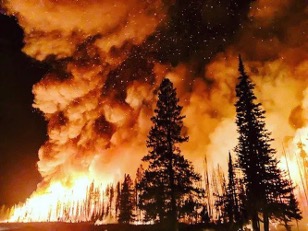
The Citizens Utility Board (CUB) of Michigan and the Michigan Municipal Association for Utility Issues (MI-MAUI) call on all electric utilities in Michigan to suspend shutoffs of electricity to all customers, and to restore power to all customers previously shut off, for the duration of the hazardous air quality event caused by wildfire smoke from Minnesota and Canada.
During wildfire smoke air quality events, health authorities urge the public – especially the elderly, young children and people with chronic health problems – to limit their time outdoors. Additional recommendations include keeping windows closed and running air filters or central air conditioning with a high-quality filter. Households whose power has been shut off obviously cannot follow this advice. In this hot weather they can either swelter in their homes or open the windows and admit hazardous, smoky air. Either choice may have serious health repercussions.
On July 16, in docket U-20140 the Michigan Public Service Commission ordered revisions to utility extreme weather shutoff protection rules. The most important step the Commission took was to adopt common statewide high and low temperature thresholds for suspension of utility disconnections. Responding to our recommendation, the Commission also ordered its staff to convene a process to evaluate the need and standards for shutoff protections during air quality events like what we are experiencing now. We support this process but in the absence of any current requirement we call on utilities to voluntarily suspend all disconnections, and to restore power wherever practical, until the air clears.
The unpredictability of air quality events caused by wildfire events underscores the need for seasonal shutoff protections, a recommendation we made that the Commission did not adopt. If meteorologists cannot accurately predict the onset, geographic extent, severity and duration of wildfire smoke air quality events, then shutoff moratoria based on forecasts will fail to protect many people. Events like this are becoming more common, as are extreme heat events. The unpredictability, severity and frequency of these events means that temporary shutoff suspensions based on weather forecasts increasingly play dice with people’s health. In addition, suspending shutoffs shortly before extreme weather and air quality events does nothing to protect the tens of thousands of households statewide that already had their power shut off. The best way to protect public health is to ensure nobody has their power shut off during the hottest and coldest months of the year. We call on the MPSC to reconsider its position on this critical issue.
Utilities object that their ability to shut off service prevents customers from running up bigger arrears and limits their bad debt losses. We reject this argument on two grounds. Morally, the most important issue here is not when people pay their utility bills but whether they stay alive and healthy. Second, the best evidence shows that disconnections have little impact on whether customers pay their bills – it only gets some of them to pay sooner. This is not a defensible reason to imperil their health and welfare by disconnecting their power.