
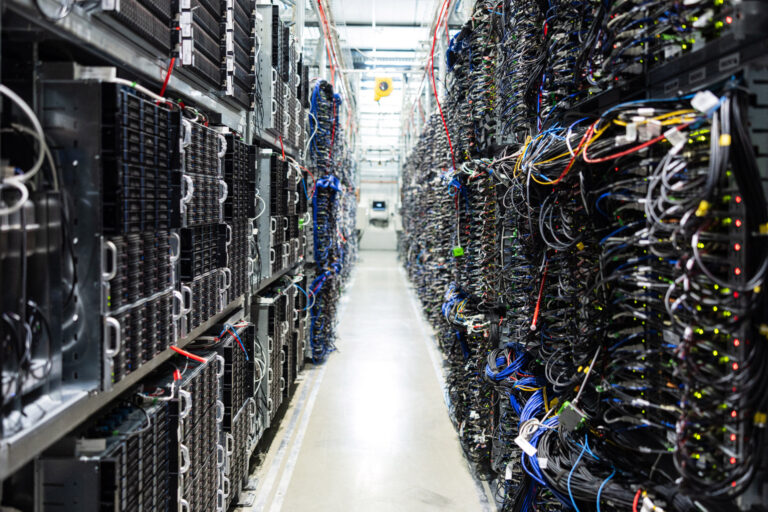
As the growth of AI drives the race to build hyperscale data centers across the country, public concern about the environmental and economic impacts of those data centers is escalating rapidly. Data centers are resource-intensive, using tremendous amounts of land, water, and electricity. Their massive consumption of power threatens to slow or even reverse progress toward a clean energy future. With a single hyperscale data center requiring the same electricity as it takes to power a large city, environmental advocates worry that data centers will hasten the construction of new fossil fuel plants or prolong the use of existing ones. Local communities are also pushing back against hosting data centers with fears of electricity price hikes. Data centers appear to be exacerbating the affordability crisis by driving up the cost of electricity for other customers in some regions.
In Michigan, regulated utilities are required to provide electricity to all customers who request it, and DTE Electric and Consumers Energy are responding to multiple requests to serve potential data centers in several locations. In case no. U-21859, Consumers Energy proposed a tariff intended to allow it to serve data centers without impacting cost or reliability of service to other customers. The coalition of the Michigan Environmental Council, Natural Resources Defense Council, Sierra Club, and Citizens Utility Board of Michigan (MNSC) intervened in the case before the Michigan Public Service Commission (MPSC), which issued an order on Nov. 6, 2025.
The MPSC’s order establishes a comprehensive framework for how Consumers Energy must structure its electric service to very large load customers—primarily data centers—under the General Primary Demand Rate (Rate GPD). The order is a response to the unprecedented scale and risk posed by these loads, aiming to safeguard existing ratepayers from bearing the cost of these loads, while enabling Michigan to attract major commercial investments.
Key Points of the Order
Who’s Covered?
- The revised tariff applies to any new customer with a load of 100 MW or greater at a single site, or an aggregated load of 100 MW+ across multiple sites under common ownership (each site must be at least 20 MW).
- The provisions are end-use neutral, meaning they apply to any qualifying large load, not exclusively data centers.
Long-Term Commitment:
- Large load customers must sign up for at least 15 years, with automatic 5-year renewals unless they give 4 years’ notice to leave or reduce their usage.
- A ramp-up period of up to five years is permitted, subject to negotiation.
Minimum Payment:
- Even if a large load customer uses less electricity than planned, they still must pay for at least 80% of what they agreed to use. This applies after the ramp-up period.
Exit Fees and Financial Security:
- If a large load customer leaves early, they pay an exit fee to cover the costs Consumers Energy spent on serving them. The exit fee is equal to the minimum billing demand multiplied by the remaining months in the contract, including infrastructure costs.
- Large load customers must provide financial guarantees (like a letter of credit or cash deposit) to make sure they can pay the exit fee if needed.
Capacity Reductions:
- Large load customers may execute a one-time discretionary reduction of up to 10% of contracted capacity with four years’ notice, without Commission approval (but must notify Staff).
- Further reductions require payment of a pro-rated exit fee or Commission review.
Administrative Fee:
- An upfront administrative fee of $100,000 is required for project proposals, reconciled to actual costs. This ensures that the cost of evaluating new large load requests is not borne by existing ratepayers.
Annual Reporting:
- Consumers Energy must report every year on how many large load customers they have, how much power they use, and any changes in contracts.
Cost Allocation and Rate Design:
- The order does not immediately create a separate rate class for large loads but requires Consumers to present six alternative cost allocation and rate design proposals in its next rate case.
- Prior to serving any large load customer under the new provisions, Consumers must file an ex parte application demonstrating that costs are not being shifted to other customers.
Clean Energy Requirements:
- Michigan law requires data centers to procure 90% of their electricity from clean sources if they wish to claim sales and use tax exemptions.
- The order does not require large load customers to buy a certain amount of renewable energy in this tariff. Instead, these issues will be handled in other proceedings.
- Consumers must discuss voluntary green pricing options with prospective large load customers.
CUB’s Contributions and Impact
CUB, as part of MNSC, played a pivotal role in shaping the order’s direction and substance:
- Advocating for Customer Protection:
MNSC pushed for strong safeguards so existing ratepayers wouldn’t end up paying for costs if a large load customer leaves or reduces usage. Our testimony and modeling demonstrated how, under traditional cost allocation, residential and commercial customers could see significant rate increases if stranded costs and cross-subsidization were not addressed. - Proposing Lower Eligibility Thresholds:
MNSC argued for including customers as small as 50 MW, to make sure more potential data centers could not split loads to avoid these terms. While the Commission chose 100 MW, it did include aggregation rules that reflect MNSC’s concerns. - Pushing for Longer Contract Terms and Higher Minimum Payments:
MNSC recommended a 20-year contract and a 90% minimum payment, based on the long life of power plants and the need for revenue certainty. The Commission settled on 15 years and 80%, but these decisions were informed by MNSC’s evidence and arguments. - Direct Assignment of Costs:
MNSC was a leading proponent of directly assigning incremental costs—generation, transmission, and distribution—associated with large loads to those customers, rather than spreading them across all ratepayers. The Commission acknowledged the validity of this approach and mandated that Consumers Energy study and propose ways to do this in future rate cases. - Administrative Fee and Transparency:
MNSC argued that the cost of studying new large load customers should not be paid by existing customers. The Commission adopted MNSC’s proposal for an upfront, adjustable fee. - Clean Energy Advocacy:
MNSC pushed for provisions to ensure data centers do not slow Michigan’s clean energy transition. In Michigan, data centers seeking tax exemptions must receive 90% of their electricity from clean energy sources. The MNSC argued that the Commission should provide a clear path to meet that requirement through a combination of voluntary green pricing programs, long-term contracts, and self-supplying clean energy. The MNSC also proposed requiring Consumers to provide at least 60% renewable energy to data center customers, regardless of whether they were seeking tax exemptions, to ensure the utility meets Michigan’s renewable energy standards. While the Commission decided to address these issues in future cases, it recognized MNSC’s leadership on the topic and the importance of early planning.
MNSC’s research, testimony, and advocacy were central to the Commission’s understanding of the risks and the need for strong protections. Many of our ideas, especially around cost allocation, contract terms, and customer protection, were reflected in the final order, even if not always adopted exactly as proposed.
Why Does This Matter?
- For regular customers:
These new rules help make sure you don’t pay higher rates because of the risks or costs created by data centers. - For Michigan’s future:
The order balances the desire to attract big, high-tech businesses like data centers with the need to protect everyone else from unexpected costs. However, the impact of data centers on Michigan’s ability to meet clean energy goals remains unclear.