
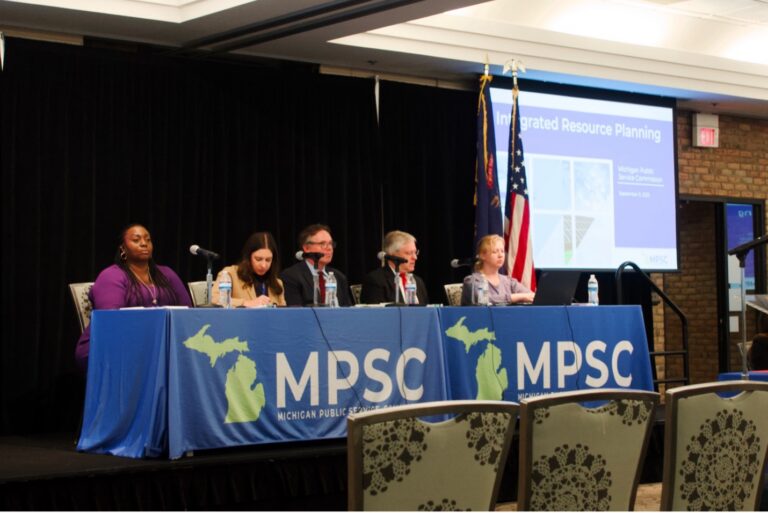
In June 2026, Michigan Gov. Gretchen Whitmer sent an open letter to the Michigan Public Service Commission (MPSC) requesting input on legislative reforms that could improve energy affordability and reliability, as well as opportunities for new or improved energy affordability assistance programs. On August 10, the MPSC made its response public.
The newly released letter from the MPSC includes several recommendations that could offer relief to Michigan’s residential ratepayers, who pay some of the highest energy rates in the U.S. and receive service that is notoriously unreliable.
The commission’s suggestions range from changing the process by which utilities request rate increases to realigning utility business incentives around grid investment. We were encouraged to see that many of the ideas outlined in the letter align with past positions taken by CUB in our case comments and testimony.
One idea that has received a lot of public attention is the elimination of annually occurring utility rate increases. We believe this could be a valuable step, especially if the enabling legislation provides more time for the MPSC to rule on pending requests. We also contend that the utilities’ projected costs, used in rate cases to plan for future changes in utility expenses, should be tied to the Consumer Price Index to prevent unnecessary rate growth.
We greatly appreciate the commission’s focus on making reliability improvements a more significant factor in rate design, calling for measures that “address the utilities’ capital bias.” CUB has repeatedly argued that utilities focus too much on expensive capital investments while neglecting modest operational expenses such as tree trimming. This is largely due to business incentives that reward utilities for investing money in specific ways. Realigning those incentives and compensating utility shareholders for measurable year-over-year reliability improvements would encourage responsible and cost-effective grid management.
There are several other key points where CUB is in alignment with the MPSC recommendations. Some examples include:
- Requiring utilities to make greater use of existing distribution infrastructure before investing in new capacity and allowing the MPSC to consider grid utilization when evaluating utility requests to recover capital costs from ratepayers.
- Requiring utilities to demonstrate that transmission investments have been considered as an alternative to building new generation.
- Allowing the MPSC to license third-party aggregators of customer-installed assets like batteries and solar panels, opening the door for residential ratepayers to earn compensation by indirectly participating in wholesale energy markets.
- Requiring more utility energy projects to be competitively procured, which can produce cost savings that can be passed on to ratepayers.
We also appreciate the MPSC’s analysis of low-income assistance programs and its suggestions around expanding eligibility, increasing assistance program funding, and focusing on weatherization support. We stand with commissioners in recognizing the importance of these programs and welcome their thoughtful analysis on how they might be improved, expanded, and better optimized.
One inclusion CUB would add to the commission’s list would be automatic enrollment in low-income assistance programs. As we discussed in our report on low-income energy insecurity, automatic enrollment could be implemented using categorical eligibility criteria such as participation in food and housing assistance programs. We also maintain that the best way to support low-income households is by ensuring energy bills do not exceed 6% of household income, and this would be best accomplished through the implementation of Percentage of Income Payment Plans.
We applaud the MPSC for answering the call from Gov. Whitmer and providing this detailed letter that charts a path for Michigan lawmakers who are concerned with energy affordability. CUB will continue working with energy experts, regulators, utility leaders and state elected officials to improve Michigan’s residential energy outlook.